
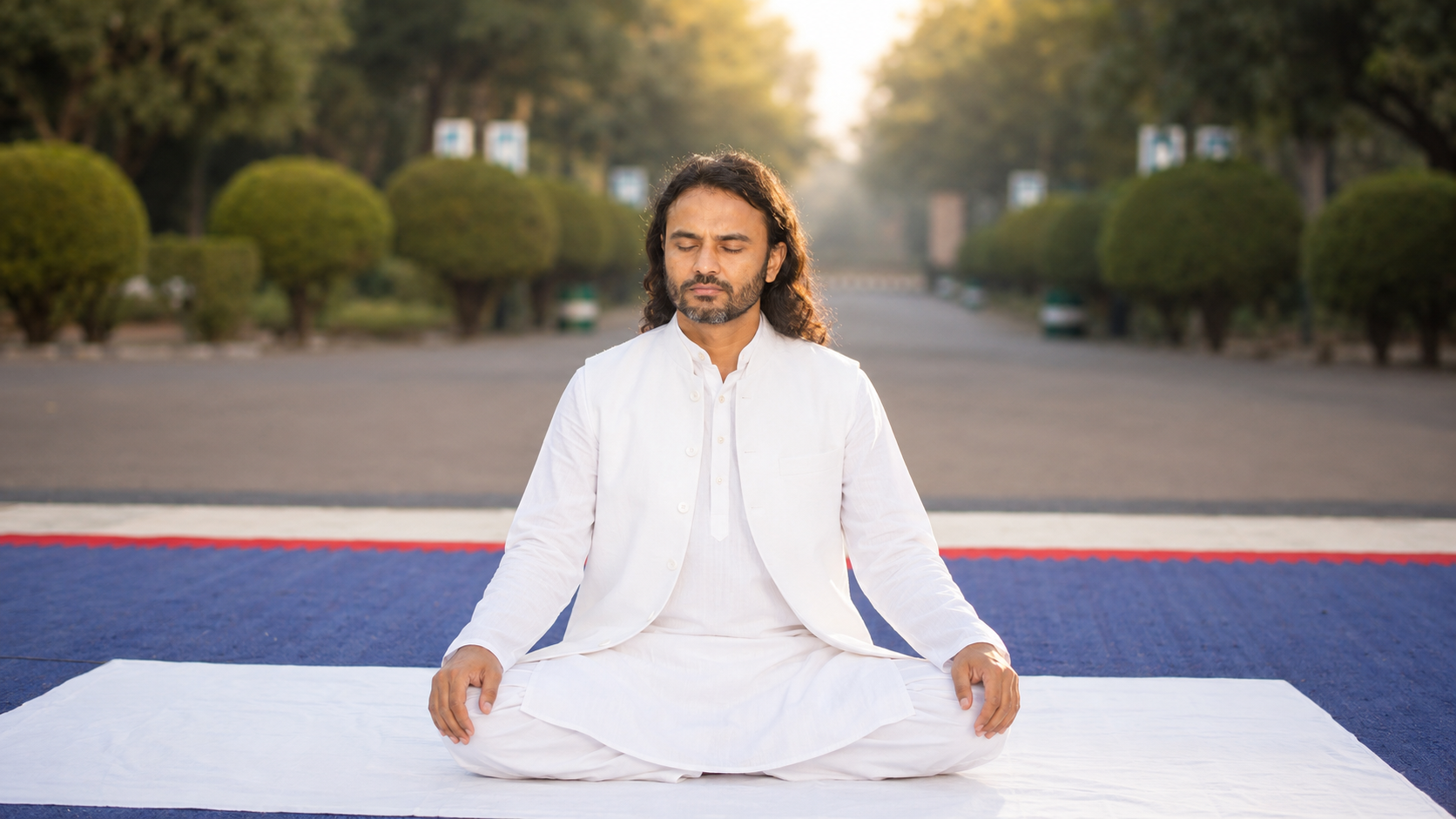
The Secret of Shallow Breathing?
4 months ago By Yogi AnoopWhat is the Secret of Shallow Breathing?
Shallow breathing is not merely about taking quick and light breaths—it reflects a deeper pattern of living. It is a state in which the breath loses its depth, its rhythm, and most importantly, its pause.
Every breath is a journey—an inward movement and an outward release. But when there is haste in both directions, something essential is lost: the stillness in between. This pause, though subtle, is where balance resides. When breathing becomes hurried, this pause shrinks, and with it, the space for awareness diminishes.
We can understand this through a simple analogy. If the heart beats 70 times per minute, there is a certain rhythm and rest within those beats. But if the rate increases to 120, the number of beats rises, yet the duration of rest within each cycle becomes significantly shorter. The rhythm remains, but the depth is lost.
The same principle applies to breathing. As the speed increases, the stillness between breaths fades. This is what may be called shallow breathing—not just a physical pattern, but a departure from one’s natural state.
Interestingly, in nature, some creatures are designed to breathe this way. For them, it is not a disturbance but an inherent rhythm. However, for human beings, the natural breath is meant to be deep, steady, and relaxed. This is because a human being is not merely biological, but also conscious—capable of awareness and inner perception.
When the mind is overwhelmed—by fear, desire, anxiety, or anger—the breath unconsciously reflects that turbulence. It becomes restless, fragmented, and shallow. In such a state, neither stillness nor grace can emerge in breathing.
From this perspective, persistent shallow breathing is not a minor issue—it is a sign of deeper imbalance.
In children, a faster and lighter breath may appear natural, as their system is still developing. But when the same pattern persists into maturity, it indicates a disconnection from one’s natural rhythm.
In my observation, shallow breathing is not merely a bodily function—it is a mirror of one’s inner condition. It often reflects a subtle dissatisfaction within. The individual is not fully connected with oneself and may have unknowingly placed the source of fulfillment outside.
Consider this: if a person cannot find contentment in the most fundamental nourishment—breath itself—how can lasting satisfaction be found in external experiences?
Breath is the most immediate form of nourishment—an invisible food that sustains life moment to moment. If one remains disconnected from this, then even sensory pleasures, actions, or achievements cannot bring true fulfillment.
Shallow breathing also suggests a lack of depth in experience. One is neither fulfilled through action nor through perception. The capacity to fully live a moment diminishes.
Take a simple example—when eating, taste is experienced only when the food is allowed to rest briefly on the tongue. If swallowed hastily, the experience is incomplete. Similarly, without a pause and depth in breathing, the experience of breath remains partial.
Thus, shallow breathing is not just a way of breathing—it is a way of living superficially.
The way forward is not force, but awareness. To breathe slowly, deeply, and consciously. To allow each breath—and each experience—to be felt fully, with a moment of stillness.
Ultimately, it is deep and balanced breathing that leads one toward contentment, stability, and a sense of wholeness.
Recent Blog
Copyright - by Yogi Anoop Academy