Principle of Stretch & Release
4 months ago By Yogi AnoopThe Principle of Stretch and Release
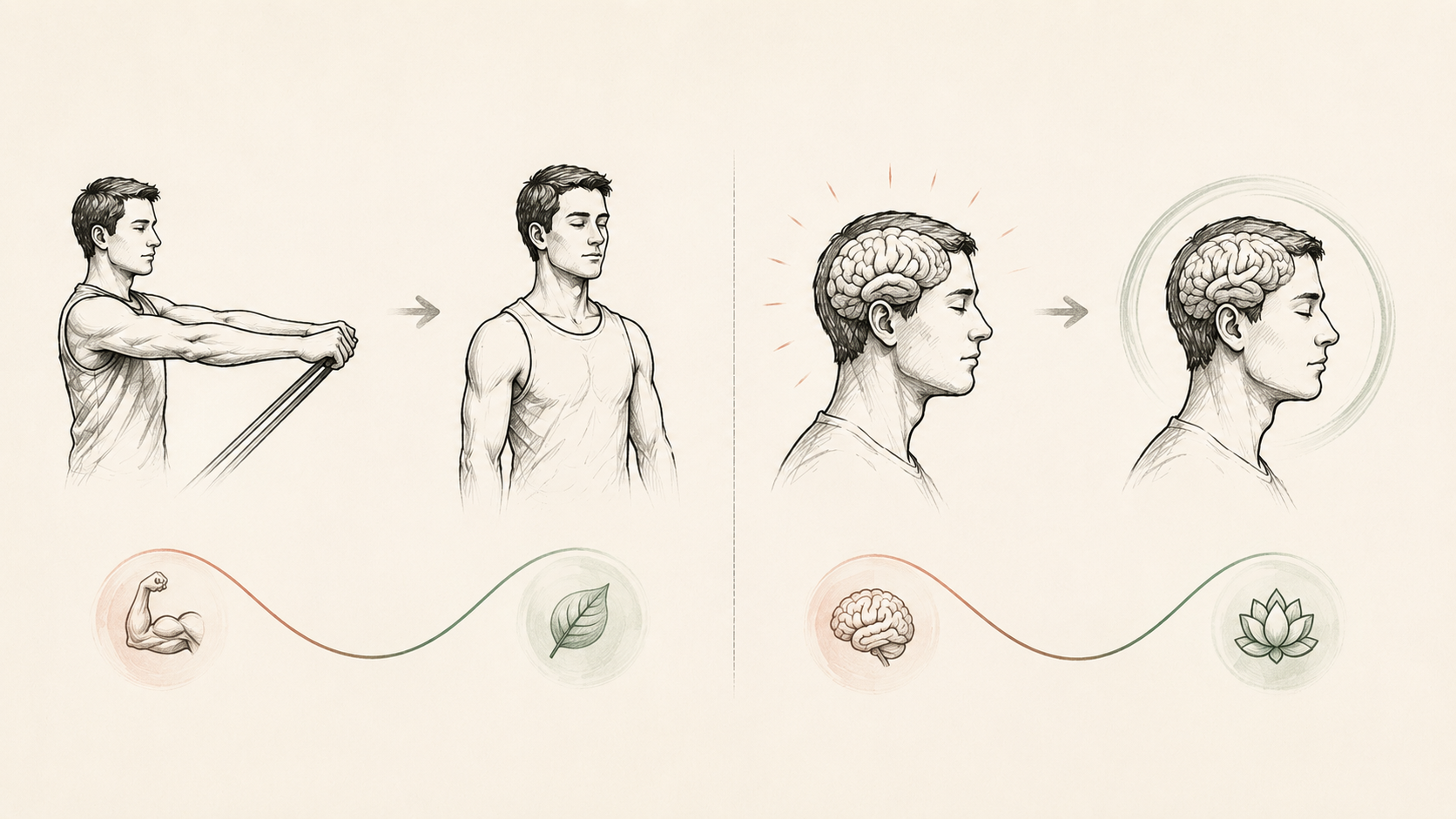
“Stretch only as far as the muscles return to their resting state effortlessly — without assistance, without resistance."
This is not merely a rule of physical conditioning. It is a profound biological and philosophical principle.
A Living Experiment — Yogi Anoop's Personal Journey
This principle did not emerge from intellectual reasoning alone. Behind it lies a long and difficult personal experience.
For nearly five years, Yogi Anoop conducted a deliberate experiment on his own body — one in which muscular stretching was pushed to its limits, while relaxation was treated as secondary. The focus was on holding each posture for extended durations: five, sometimes ten minutes at a time. This was a natural consequence of following the prevailing methods of practice at the time.
But after several years, the symptoms that began to surface in both body and mind became living proof of what this principle warns against:
- Mood swings — the mind becoming unstable without any apparent external cause
- A persistent heaviness and pain in the head — one that did not ease even after rest.
- A constant tension somewhere in the body — as though the muscles had simply forgotten how to let go.
- A quiet, causeless fear residing in the chest — unconnected to any event or thought.
- Frequent, odourless belching — and food digesting unusually fast.
These were not separate, unrelated symptoms. They were different expressions of a single underlying imbalance — the pattern of tension had taken such deep root in the body and mind that relaxation had become an unfamiliar, almost foreign state.
It was this experience that led Yogi Anoop to the principle presented here.
What Happens When Stretching Goes Too Far
When muscles are stretched beyond what is necessary, and are not given adequate opportunity to release, a distorted cycle begins to form. Gradually, the muscles begin to treat tension as their natural state — and relaxation becomes something they no longer recognise. What was once extraordinary becomes, through repetition, ordinary. And within that ordinariness, the seed of dysfunction is quietly planted.
Modern neuroscience calls this **maladaptive neuromuscular patterning** — the nervous system begins to register a distorted pattern as its new normal.
The Conversation Between Mind and Muscle
Here lies a subtle but essential truth: muscles do not decide on their own. They follow the signals of the mind.
When the mind begins to derive excitement and pleasure from tension — and grows indifferent toward rest — the muscles it governs gradually begin to reflect the same disposition. This creates a **mind-muscle feedback loop**, in which body and mind pull each other deeper into the same distorted direction.
In the language of Indian philosophy, this is the formation of a particular *samskara* — a deep impression. The impression of tension becomes so dominant in the *chitta* (the field of consciousness) that the experience of relaxation begins to feel either unbearable or meaningless.
This is precisely why the classical texts cautioned against allowing *rajasic* tendencies — tendencies that elevate tension, that agitate the mind and senses, that mistake stimulation for vitality — to take root in the inner life.
Long-Term Consequences — Mind, Body, and the Glands
After years of such practice, the imbalance does not remain confined to the muscles. The mind becomes permanently drawn toward stimulation and arousal. It begins to drift away from stillness, silence, and ease. This is where the roots of mental restlessness, anxiety, and instability quietly take hold.
At an even subtler level, the **endocrine glands** receive the same distorted signal — and begin to oversecrete. The hormonal imbalance of stress hormones like cortisol and adrenaline is the biological evidence of this process. Secretion swings between excess and insufficiency. And when output drops, the body, now conditioned to stimulation, drives itself back toward tension — toward more practice, more movement, more exertion. Many people, the moment their glands begin to slow their output, instinctively turn to the gym. They feel balanced again for a while. But a cycle has formed.
The consequences that follow are entirely natural: anxiety, poor sleep, irritability, emotional volatility. These are not random afflictions — they are the predictable outcomes of this imbalance.
Whether Yoga or the Gym — The Principle Is the Same
It does not matter whether the excess tension comes from an intensive yoga practice, as in Yogi Anoop's case, or from relentless training in the gym. If rest is treated as neglect — if tension and load are seen as achievement, and relaxation is dismissed as laziness — then dysfunction in body and mind is not a possibility. It is a certainty. There is no stopping it.
In any practice — whether of the mind, the senses, or the muscles of the body — if only the effort is honoured and the release is ignored, the problems will only deepen with time.
The Essence: The balance of stretch and release is health itself.
The muscle that can return to ease after exertion — that is a healthy muscle.
The mind that can settle into stillness after stimulation — that is a balanced mind.
The glands that secrete as needed, neither in excess nor in deficit — those are the foundation of life.
This is the law of nature. This is the root of yoga.
Recent Blog
Copyright - by Yogi Anoop Academy