Pranayama for Heart Health
4 months ago By Yogi AnoopDeep Chest Breathing — An 11-Minute Inner Alignment for the Heart
Before this becomes a practice, it must first become a perspective.
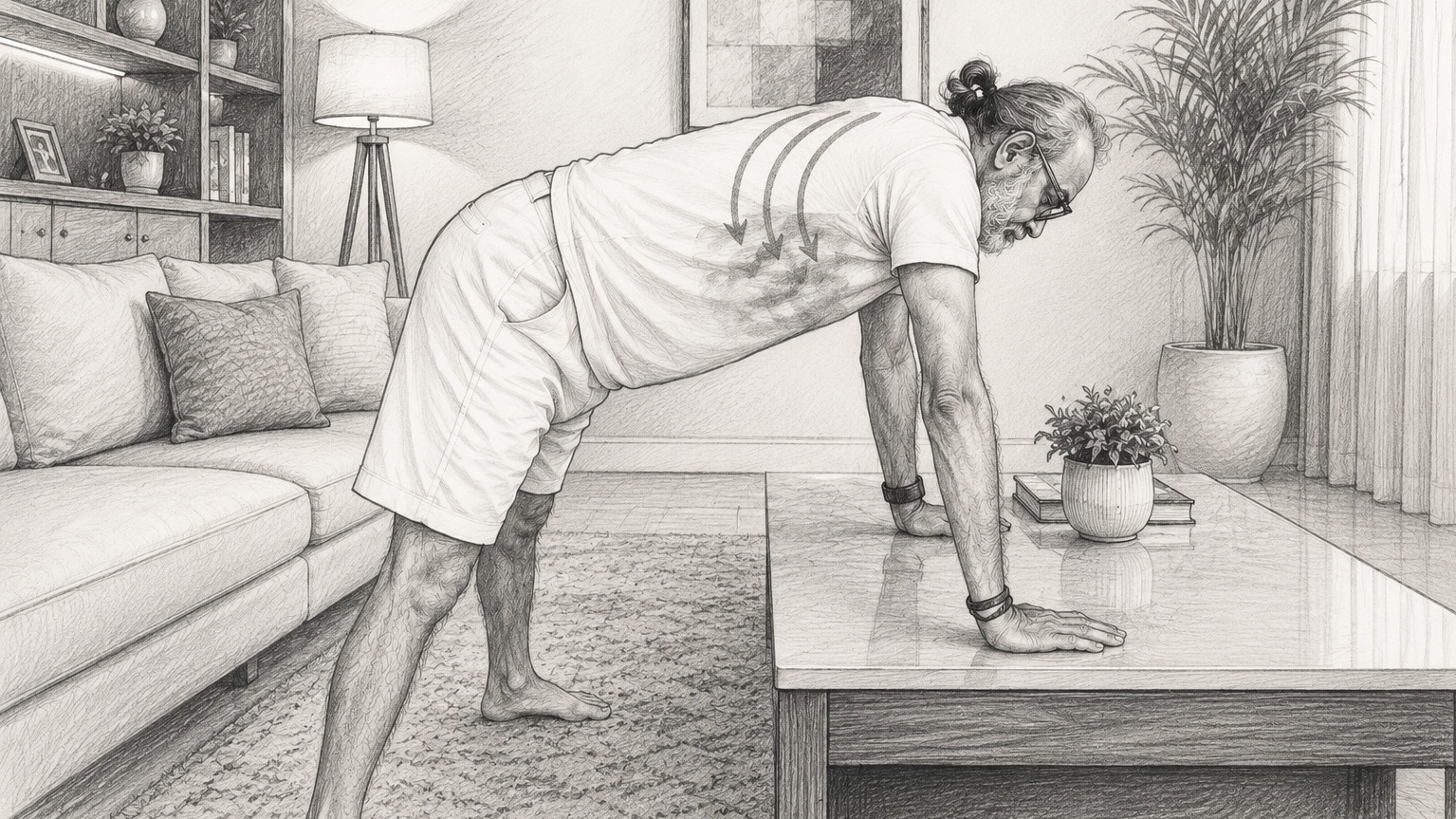
The Angle: Where the Body Listens to Gravity
There is a subtle intelligence in how the body is placed. When you lean slightly forward, resting your hands on a support, something quiet yet profound begins to shift. The heart is no longer working against gravity in the same way—it is gently assisted by it.
In this inclined posture, blood finds its way toward the heart with less resistance, almost as if nature itself is participating in the process. And wherever blood gathers, life follows—oxygen, awareness, and vitality all begin to converge in that space.
This is why the angle matters. Not as a mechanical adjustment, but as a doorway.
A doorway where breath, blood, and attention begin to meet.
The Practice: A Journey, Not a Technique
1. Receiving the Breath
Do not take the breath—receive it.
Let it enter slowly through the nose, as if you are welcoming something subtle and nourishing. The chest does not inflate forcefully; it unfolds. It rises, expands, and even the back of the body participates in this quiet opening.
This is not consumption, like filling a container.
This is participation—like tasting something with awareness.
2. The Pause: Where Movement Dissolves
After the inhalation, there is a natural moment where everything becomes still.
Do not think of it as “holding” the breath. Holding creates tension.
Instead, see it as a space where the journey pauses on its own.
In that pause, time loosens. The mind slows down—not because you forced it, but because there is nowhere to go.
This is the silent interval where the breath is no longer moving, and yet something deeper is being absorbed.
Not just oxygen—but stillness.
3. Letting Go of the Breath
When the breath leaves, do not push it out.
Let it fall away, the way a leaf lets go of the branch when it is ready. The body knows how to release—your interference is not required.
In this effortless exhalation, a quiet surrender happens.
The chest softens, the mind unwinds, and something within you settles without instruction.
4. Rhythm: The Invisible Discipline
Inhale… pause… release.
These are not steps to be executed, but phases to be understood.
To truly feel this rhythm can take years—not because it is complex, but because it is subtle.
The practice asks for no force, only consistency.
At least eleven minutes—not as a rule, but as a threshold where the surface mind begins to fade, and a deeper intelligence starts to emerge.
What Begins to Change
When breath, posture, and awareness align, the body does not merely function—it reorganizes itself.
- The heart is supported, not strained. Its rhythm finds a quieter balance.
- The breath deepens, and with it, the mind loses its restlessness.
- Tension stored in the chest and upper back begins to dissolve, not through effort, but through space.
- The nervous system shifts—from urgency to restoration, from survival to healing.
- Even emotional patterns begin to soften, as if the inner climate is slowly changing.
This is not a quick remedy.
It is a gradual remembering of how the body was always meant to breathe.
A Few Gentle Boundaries
Do not bend too much—comfort is the guide.
Do not force the pause—let it appear.
If the body resists with dizziness or unease, listen and stop.
And if the heart has known illness or the body has recently undergone strain, wisdom lies in seeking guidance before entering deeper.
In Essence
This is not merely breathing.
It is a meeting point—
between the body’s position,
the movement of breath,
and the stillness of awareness.
When these three come into harmony, healing is not something you do.
It is something that quietly begins to happen.
Recent Blog
Copyright - by Yogi Anoop Academy