
Excess Gas and Its Retention
4 months ago By Yogi AnoopExcess Gas and Its Retention: What Is the Real Cause?
Many people complain that gas forms in their stomach, yet it does not pass easily. It seems to get stuck. When this happens, it not only creates tightness in the abdomen but also generates a subtle tension in the mind.
Conventionally, the cause is attributed to improper diet. It is believed that overeating or consuming the wrong kind of food leads to excessive gas formation, creating pressure within the digestive and excretory organs—pressure that the body is unable to neutralize.
At a surface level, this explanation holds some truth. But what about those individuals who eat simply, who neither overeat nor indulge in unhealthy food, and yet experience the same issue? What, then, is the real cause?
The inquiry here is deeper: what is the root of this imbalance in people whose lifestyle appears disciplined?
Through my own practical observation and meditative exploration, I have found that the root is not physical, but mental. It lies in a subtle, often unconscious activity of the mind—a constant, hidden tendency to contract the abdomen.
The mind, without awareness, keeps pulling the stomach inward. The individual does not even realize that they are holding their abdominal organs in a state of tension. Now, if food is consumed in this state, it is natural that digestion and elimination become irregular. This irregularity itself gives rise to excessive gas. And because the abdomen remains contracted, the body cannot release it easily.
In my experience, nearly 80% of individuals who come with such complaints have no real dietary issue. Yet they suffer from excessive gas. Upon deeper observation, it becomes evident that they have developed a habit of constantly tightening their abdomen.
Even medical examinations often reveal no physical disorder. Eventually, such individuals are labeled as anxious or depressed. But in my understanding, the issue is more subtle than anxiety—it is an unconscious habit of holding the abdomen tight, a pattern the individual is not even aware of.
I have also observed that when this mental habit is present, even the simplest and cleanest food can become problematic. The issue is not the food—it is the internal state in which the food is received. The result is excessive gas formation. Though not necessarily a disease, it disrupts daily life. The person feels low, distracted, and gradually their physical and mental capacity declines.
Interestingly, such imbalances are far more common than actual diseases. A body without illness can still feel deeply disturbed due to such internal tension.
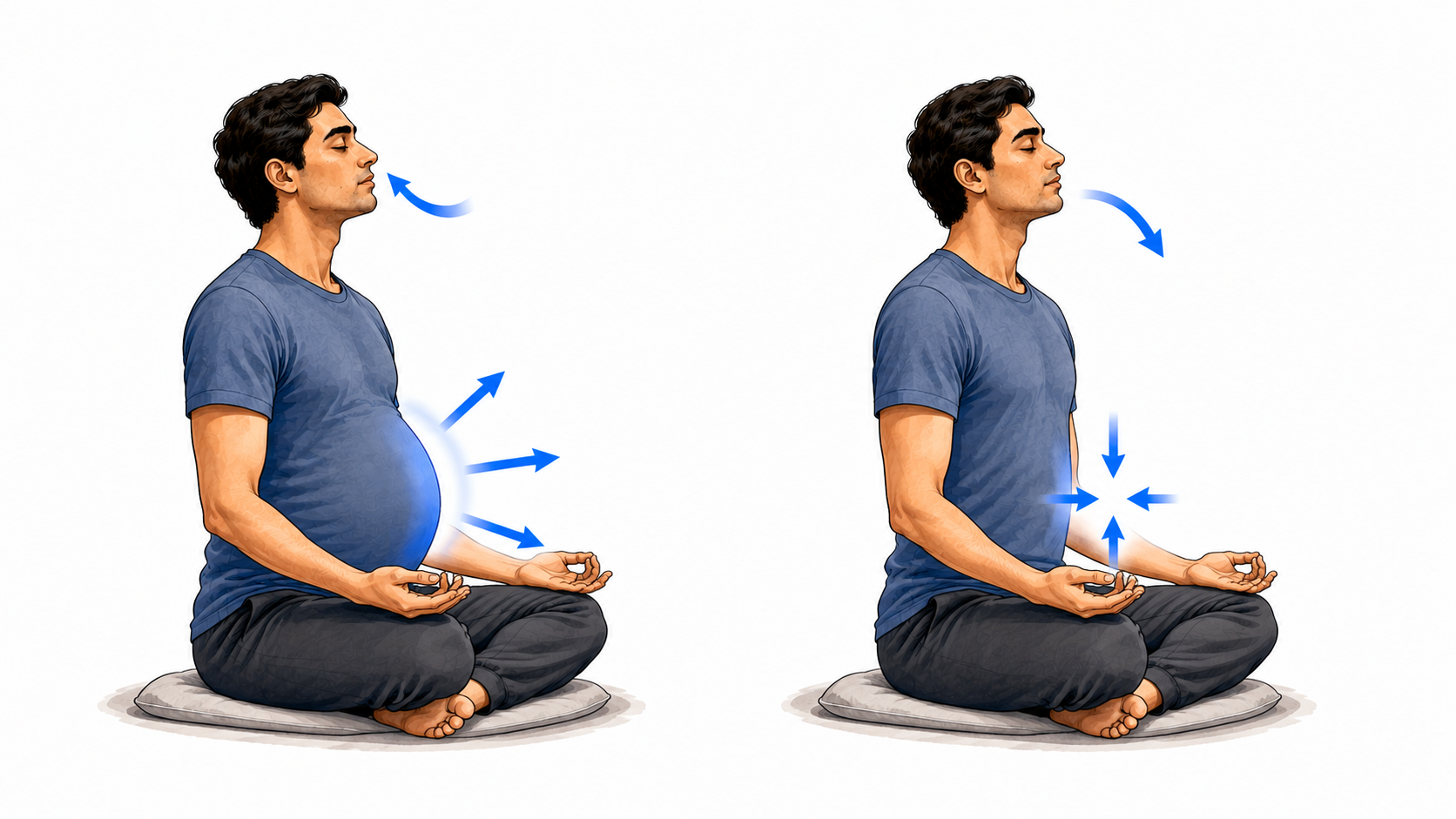
This is why, in my yogic approach, I emphasize methods that help release the abdomen. The moment a person learns to consciously relax the stomach—through yogic practices and pranayama—relief begins immediately. In many cases, even 11 minutes of proper breathing practice can help release trapped gas with surprising ease.
I have personally experienced that even when there seems to be no gas present, simply relaxing the abdomen during pranayama can lead to its release. This reveals how deeply the body was holding tension without awareness.
That is why I say: gas cannot leave the body unless the muscles of the abdomen and its surrounding structures are relaxed. Here, “abdomen” includes not just the upper stomach where belching occurs, but also the lower abdominal region—the intestines.
If the stomach, diaphragm, and abdominal muscles remain tight, the release of gas becomes almost impossible. Not only that, even the prevention of excess gas formation becomes difficult. When unnecessary tension is removed, excessive gas simply does not arise. I consider myself a living example of this.
However, recognizing this tension is not easy. A person often says, “Why would I tighten my own body?” But the question is not “why”—it is “how unconsciously it is happening.”
When the mind is restless and moving rapidly, it seeks subtle ways to slow itself down. One such way is by gripping parts of the body. Just as a person may unconsciously bite their nails—not for taste or need, but as an outlet for inner restlessness—similarly, the abdomen too becomes a site of unconscious contraction.
This is why identifying this tension takes time—sometimes months or even years.
The first step, therefore, is awareness: to recognize that the abdomen is being held unnecessarily. Once this awareness arises, it becomes much easier to release the tension through yogic practices. And with that, disturbances related to gas begin to resolve naturally.
Practices such as abdominal breathing and diaphragmatic breathing are especially powerful in relaxing the abdominal muscles. Through these, not only does the issue of gas improve, but the entire body and mind experience a profound sense of ease.
Ultimately, the goal is not merely to expel gas, but to understand what is preventing its natural movement. And more often than not, that cause lies in one simple truth—unnecessary tension held within the body.
Recent Blog
Copyright - by Yogi Anoop Academy