
A Subtle Disorder of the Mind
4 months ago By Yogi AnoopA Subtle Disorder of the Mind —
Viparyaya & False Knowing: When the Mind Chooses Comfort Over Truth
There is a quiet yet deeply rooted distortion within the human mind—the inability to perceive a thing as it truly is. In the language of Yoga Sutras of Patanjali, this distortion is called Viparyaya. It is described as: “Viparyayo mithyā-jñānam atad-rūpa-pratiṣṭham”—false knowledge is that which is established not in the real nature of the object, but in something else entirely.
This is not merely an error of information; it is a deformation in the very act of seeing. Consciousness, instead of resting in what is, begins to project what it wants to see. The mind slowly replaces reality with interpretation, and interpretation with imagination.
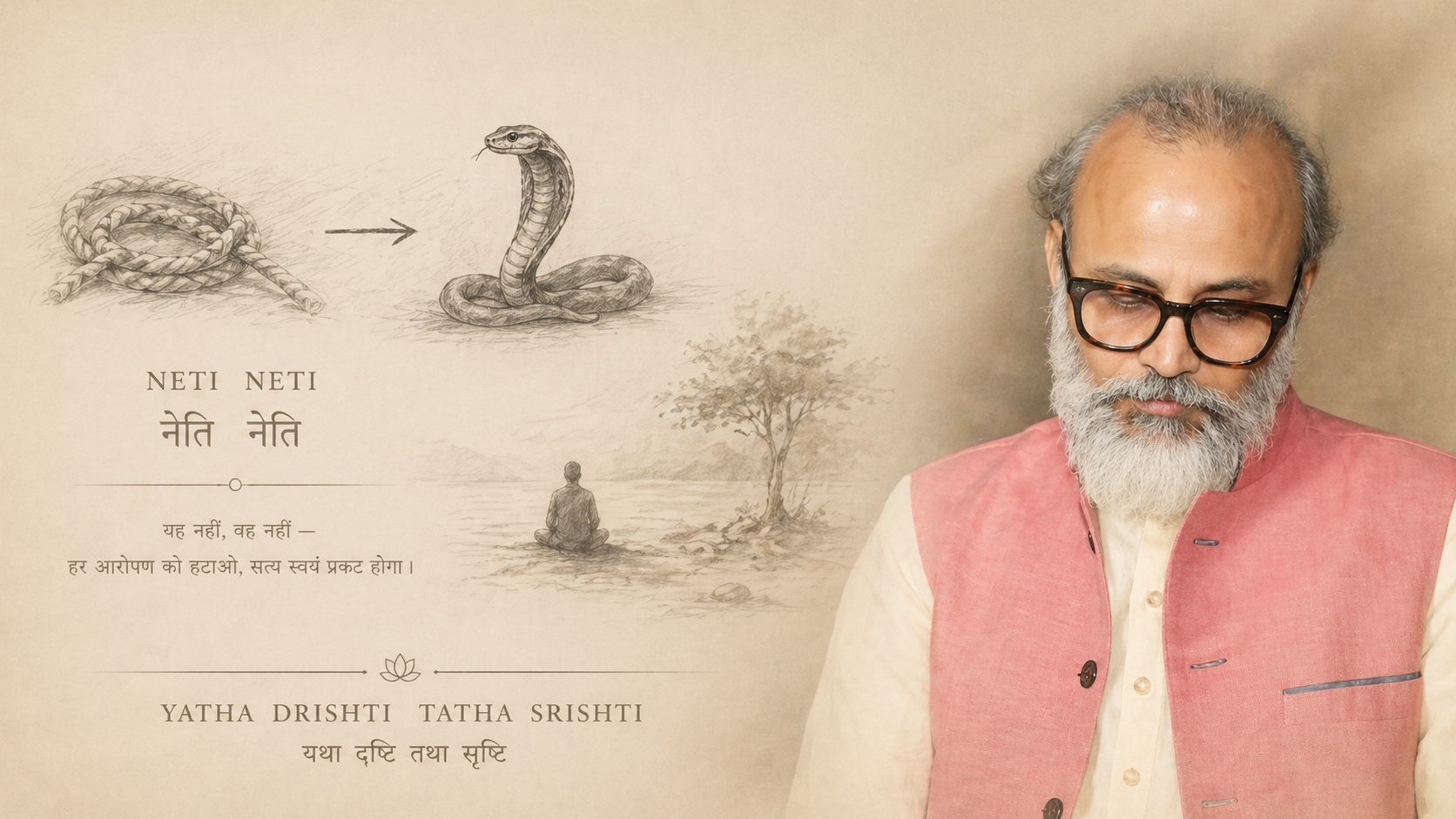
If we move deeper into this inquiry, we find that the Upanishads echo this insight in many subtle ways. They suggest that what we perceive as the world is not the complete truth of things, but rather a web of meanings superimposed by our own consciousness. Through the method of “Neti, Neti”—“not this, not that”—they invite us to peel away each layer we have unconsciously placed upon reality.
To know a thing, then, is not to accumulate more ideas about it, but to dissolve the layers of illusion we have wrapped around it.
In ordinary life, this distortion unfolds continuously. Mistaking a rope for a snake in the dark is not just an example—it is a metaphor for how perception is shaped by fear. We do not see the rope; we see our anxiety. A shadow becomes a ghost, a snow-covered mountain becomes the form of a deity. The object remains unchanged—only our vision shifts.
The Upanishadic insight, “Yathā dṛṣṭi tathā sṛṣṭi”—as the vision, so the world—reveals something even more profound: the world we experience is not independent of how we see it. The same object can appear sacred to one and trivial to another. The same body can be revered as a temple or dismissed as a temporary collection of elements. The duality is not in the object—it is in the observer.
The distortion lies not outside, but in the way of seeing.
This becomes evident even in simple acts. Many people, while eating, imagine they are consuming something divine. While this may appear devotional, it often leads to excess—because the food is no longer seen as nourishment, but as something emotionally charged. The mind subtly shifts the object into a symbol that gratifies its own tendencies. In doing so, it is no longer relating to reality, but to its own projection.
And if we observe this process more carefully, a deeper truth begins to reveal itself: the mind distorts reality because it prefers psychological comfort over truth.
To see something as it is—plain, unembellished, without narrative—is not particularly appealing to the mind. Reality, in its raw form, lacks the sweetness of imagination. It does not entertain, it does not reassure. So the mind reshapes it—adding meaning, emotion, and story—until it becomes something more agreeable, more secure, more pleasurable.
Here, the Upanishads introduce another crucial dimension: Avidyā—ignorance. But this ignorance is not simply the absence of knowledge; it is the persistence of wrong knowledge. When this distortion repeats itself over time, it ceases to be a momentary illusion and becomes a habitual way of seeing. We begin to interpret every experience through the same lens, and gradually, this lens becomes our reality.
Thus, Viparyaya—false perception—is not an external event. It is an inner movement where the mind gives priority to its fears, its desires, its conditioning, over the actuality of the object.
And as long as this tendency continues, truth remains inaccessible—because what we are encountering is not the object, but the reflection of our own mind upon it.
The Upanishadic inquiry ultimately brings us to a simple yet profound question:
Can we see something exactly as it is—without projection, without fear, without desire, without imagination?
This question is not philosophical—it is the very beginning of sādhanā.
Because when perception becomes clear, not only does the object reveal itself in its true form, but the one who sees also begins to emerge in clarity. In that moment, distortion dissolves.
And where distortion ends—truth quietly begins.
Recent Blog
Copyright - by Yogi Anoop Academy